Перейти к содержимому
ganieva92

ganieva92

На сайте с 22 января 2013 г.

Пользователь пока ничего не рассказал о себе.

рейтинг

100

постов

10

комменты

16

подписчик

1

подписок

0

Phonetic and graphic stylistic devices

Onomatopoeia (sound imitation) is a combination of speech sounds which imitate sounds produced in nature (wind) by things (tools), by people (laughing), by animals (barking). ▲ plink, plink, fizz. Direct onomatopoeia: words which imitate natural sounds. ▲ buzz. Indirect: combination of sounds which makes the sound of the utterance an echo of its sense. ▲ Камыши шуршат в тиши. Alliteration: repetition of similar consonant sounds in close succession. ▲ Functional, fashionable, formidable. Assonance: repetition of similar vowel sounds, usually in stressed syllables. ▲ Grace, space,pace. A phoneme has a strong associative and sound-instrumenting power. Due to its articulatory and acoustic properties certain ideas, feelings, images are awaken. It’s vivid in poetry. Euphony: produced by alliter…
0
1
15702

Repetition and it's types.

Repetition as a stylistic device is a direct successor of repetition as an expressive language means, which serves to emphasize certain statements of the speaker, and so possesses considerable emotive force. There are many classifications of these stylistic device and i'll give you one of them because i think it's very difficult to determine the type of repetition. Conduplicatio is the repetition of a word in various places throughout a paragraph. "And the world said, 'Disarm, disclose, or face serious consequences'—and therefore, we worked with the world, we worked to make sure that Saddam Hussein heard the message of the world." (George W. Bush) Mesodiplosis is the repetition of a word or phrase at the middle of every clause. "We are troubled on every side, yet not distressed; we are pe…

0
5
2334

Syntactical Stylistic devices

Inversion/Change of Word Order aims at making one of the members of the sentence more conspicuous, more important, more emphatic.‘Talent Mr.Micawber has; capital Mr.Micawber has not.’Came frightful days of snow and rain. Repetition Repetition is used when the speaker is under the stress of strong emotions. It shows the state of mind of the speaker.‘Stop!’-she cried. ‘Don’t tell me! I don’t want to hear; I don’t want to hear what you’ve come for. I don’t want to hear.’ The repetition ‘I don’t want to hear’ shows the excited state of mind of the speaker. Repetition aims at fixing the attention of the reader on the key-word of the utterance. Climax/Gradation Climax/Gradation is the arrangement of sentences which secures a gradual increase in significance, importance or emotional tension in t…

0
3
10316

In my blogs there is no information about 2 figures of speech, therefore this blog is dedicated to them.

Epitet The epithet is based on the interplay of emotive and logical meaning in an attributive word, phrase or even sentence, used to characterize an object and pointing out to the reader some of the properties or features of the object with the aim of giving an individual perception and evaluation of these features or properties. Euphemism A euphemism (from the Greek words eu - well and pheme - speak) is a word or expression that is used when people want to find a polite or less direct way of talking about difficult or embarrassing topics like death or the bodily functions. Most people, for example, would find it very difficult to say in plain language that they have arranged for their sick old dog to be killed. They would soften the pain by saying: We had Fido put down or We had Fido put…

0
2
590

Understatement. Hyperbole. Oxymoron. Periphrasis.

Figure of speech Hyperbole Understatement Periphrasis Oxymoron Definition A figure of speech (a form of irony) in which exaggeration is used for emphasis or effect; an extravagant statement. A figure of speech in which a writer or speaker deliberately makes a situation seem less important or serious than it is. Contrast with hyperbole. Periphrasis is a roundabout way of referring to something by means of several words instead of naming it directly in asingle word or phrase. A figure of speech in which incongruous or seemingly contradictory terms appear side by side; a compressed paradox. To which group it belongs: - according to I. R. Galperin - according to Kukharenko - according to Screbnev Lexical SDs and EMs Lexical SDs Paradigmatic semasiology units Lexical SDs and Ems Lexical SDs Pa…

0
4
1359

Pun — Zeugma — Irony — Malapropism

Figure of speech Pun Zeugma Irony Malapropism Definition A play on words, either on different senses of the same word or on the similar sense or sound of different words. Also known as paronomasia. The use of a word to modify or govern two or more words in such a manner that it applies to each in a different sense or appropriate to only one. Irony is a figure of speech in which an expression means something the opposite of or very contrary to its literal meaning. Absurd or humorous misuse of a word, especially by confusion with one of similar sound. To which group it belongs: - according to I. R. Galperin - according to Kukharenko - according to Screbnev Lexical SDs and EMs Lexical SDs Units of syntagmatic semasiology Lexical SDs and Ems Lexical SDs Units of syntagmatic semasiology Lexica…

0
6
633

Metaphor Simile Personification Metonymy

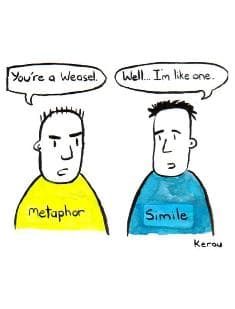
Figure of speech Metaphor Simile Personification Metonymy Definition A metaphor is defined as an indirect comparison between two or more seemingly unrelated subjects that typically uses “is a” to join the subjects. A simile is where two things are directly compared, and “as” or “like” is usually used to compare. Personification is giving human traits (qualities, feelings, action, or characteristics) to non-living objects (things, colors, qualities, or ideas). Figure of speech where an object’s name is replaced with another name that is closely connected with it. Formula A is B A is like B To which group it belongs: - according to I. R. Galperin - according to Kukharenko - according to Screbnev Lexical SDs and EMs Lexical SDs Paradigmatic semasiology units Lexical SDs and Ems Lexical SDs P…

0
7
734

Metaphor

A metaphor is defined as an indirect comparison between two or more seemingly unrelated subjects that typically uses “is a” to join the subjects. The formula of metaphor: A metaphor casts a first subject (tenor) as being equal to a second subject (vehicle) in some way. Thus, the first subject can be economically described thanks to the implicit and explicit attributes of the second. There are many classifications of metaphors, but the classification which you gave us the most simple and clear. Semantically there are: - genuine, which possess extreme degre of unexpectedness, according to Galperin; For example when I think of love, i want to say love is a perfume, because we fill it from a distance and for a long time if it's trully and vice versa it quickly erode if not real. - trite, ofte…

0
1
527

My first post!

Hello! I'm glad to join this community. After our first lecture, I think that Stylistics is a very interesting science. I knew that Stylistics is the science of speech styles and means of expression. Now I would like to learn how to analyze the text, to find the means of expression and to be able to use them in my speech, because we as philologists should be able to express our thoughts correctly and beautifully.

0
1
101