Перейти к содержимому
Assel_91

Assel Sharapatova

@Assel_91

На сайте с 23 января 2013 г.Казахстан, Павлодар

Пользователь пока ничего не рассказал о себе.

рейтинг

100

постов

10

комменты

14

подписчик

1

подписка

1

Onomatopoeia, Assonance, Alliteration, Rhyme,

Onomatopoeia types: direct (contained in words that imatate natural sounds) and indirect (which a combination of sounds making the sound reflection of the meaning)

2 Assonance

3 Alliteration


4 Rhyme

The repetition of identical/similar ending sound combinations.

Some examples:


http://www.allposters.com/-sp/Alliteration-Posters_i6890906_.htm

http://mr-mason.wikispaces.com/Alliteration

http://www.thebadchemicals.com/?p=1683

1
1
4003

Parallel construction-Polysyndeton, Rhetorical question-Question-in-the-narrative

Parallel construction - is recurrent syntactical similarity. Several parts of a sentence or several sentences are expressed similarly to show that the ideas in the parts or sentences are equal in importance. E.g. "There were, ..., real silver spoons to stir he tea with, and real china cups to drink it out of, and plates of the same to hold the cakes and toast in. " (Dickens) Parallel constructions are often backed up by repetition of is (lexical repetition) and conjunctions and prepositions polysyndeton). Parallel constructions may be partial or complete. Partial parallel arrangement is the repetition of some parts of successive sentences or clauses as in: "It is the mob that labours in your fields and serve in your houses - that man your navy and recruit your army, - that have enabled yo…

0
3
1858

Antithesis-Ellipsis-Rhetorical question-Litotes

Antithesis (ænˈtɪθɪsɪs)- a rhetorical term for the juxtaposition of contrasting ideas in balanced phrases or clauses. "Love is an ideal thing, marriage a real thing."(Goethe) "Everybody doesn't like something, but nobody doesn't like Sara Lee."(advertising slogan) "You're easy on the eyesHard on the heart."(Terri Clark) Ellipsis (ɪˈlɪpsɪs)- the omission from a sentence or other construction of one or more words that would complete orclarify the construction, as the omission of who are, while I am, or while we are from I like tointerview people sitting down. "Prosperity is a great teacher; adversity a greater."(William Hazlitt) "May be", the autor had written, "the best course of action ... is doing nothing at all." You know, after talking it over, I still can't decide ... , but I hope to…

0
4
2691

Epithet and periphrasis

Epithet - a rhetorical term for an adjective (or adjective phrase) used to characterize a person or thing. Examples: I had reached a delicate corner. The idle road stretched for miles. All I can say is that he had an honest end. Semantically epithets split into: Associated (wide sea) Unassociated (bootless cries) Fixed (happy birthday) Structurally epithets split into: Simple (careful attention) Compound (cloud-shapen giant) Phrase (I-am-not-that-kind-of-girl look) Reversed (a hook of a nose) Transferred (merry hours) Two-step (an unnaturally mild day) String of epithets (good for nothing brute) - is circumlocution, talking around the subject rather than directly what perhaps might be said in the circumstances. Examples: It is not that James is welcome or otherwise, or that he is sometime…

0
0
797

Oxymoron-Understatement-Hyperbole

Oxymoron – (from Greek – “wittily foolish”) a figure of speech in which incongruous or seemingly contradictory terms appear side by side. Oxymorons from Everyday Life Great Depression Cruel to be kind Pain for pleasure Clearly confused Beautifully painful Original copy Sentence Examples with Oxymorons "I like a smuggler. He is the only honest thief." - Charles Lamb "I am busy doing nothing." "I am a deeply superficial person." - Andy Warhol Purpose of Oxymorons -Dramatic Effect -Adding Flavor to Speech -For Entertainment Understatement – is when something is said that is far less than what is true. Examples "It's a bit yellow" - while describing a very yellow canary. "There is some music by Beethoven in his Ninth Symphony" - while describing Beethoven's famous work. "The desert is sometim…

0
2
2075

Pun — Zeugma — Irony — Malapropism — The Violation of phraseological units

PUN - a play on words, either on different senses of the same word or on the similar sense or sound of different words. Also known as paronomasia. Bookworm Pool table Examples: "Why is it so wet in England? Because many kings and queens have reigned there." "Why can a man never starve in the Great Desert? Because he can eat the sand which is there." "At a pizza shop: 7 days without pizza makes one weak." ZEUGMA - this is a stylistic device that plays upon two different meanings of the word — the direct and the figurative meanings, thus creating a pun. The effect comes from the use of a word in the same formal (grammatical) relations, but in different semantic relations. Examples: "She dropped a tear and her pocket handkerchief." "She possessed two false teeth and a sympathetic heart." "He…

0
5
7709

Metonymy

is a word or phrase that is used to stand in for another word. Sometimes a metonymy is chosen because it is a well-known characteristic of the word. Examples: White House ->refers to the President and his staff. The building isn’t part of the President, it’s just closely related/associated. Pentagon -> refers to the military and civilian staffers. Again, the building isn’t part of them. The term’s just closely related. Hollywood -> We often refer to the film industry as Hollywood. However, not all of the film industry is in Hollywood. Synecdoche understanding one thing with another: the use of a part for the whole, or a whole for the part (a form of metonymy) ANTONOMASIA In rhetoric, the use of an epithet to acknowledge a quality in one person or place by using the name of anothe…

0
1
410

metaphor and simile

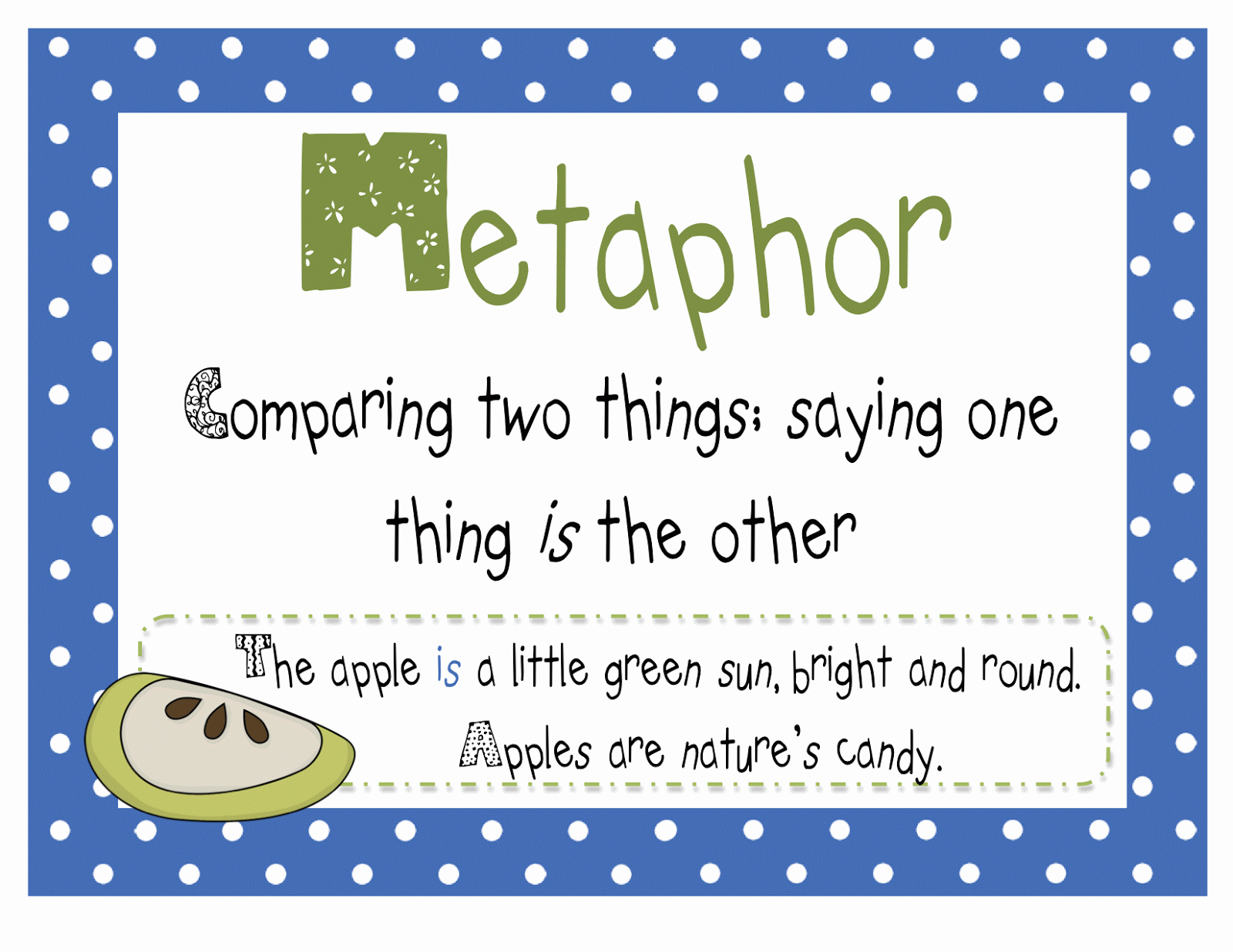
Similes and metaphors are close cousins.  Both are comparative devices that a writer can use to great effect. A simile is a direct comparison of two unlike things generally using the words “like,” “as,” or “than” to make the connection.

A metaphor is an implied comparison in which the object of description becomes something else without the use of the simile’s usual modifiers:


0
2
1566

Metaphor

Metaphor it is a figure of speech, it shows likeness  in things that are basically different. Metaphor has two parts: tenor and vehicle. And metaphor is expressed by noun, adj., verb and adverb. There are two types of metaphor: semantically and structurally. Semantically consists of genuine and trite,structurally: simple, prolonged and mixed. In our time we often hear and use metaphor. For examlple in the song 'Everything' Michael Buble use a lot of metaphors: "you're every line", "you're every word", "you're everything", "you're carousel" etc. In the mataphor "you're carousel" tenor-you and vehicle-carousel. I think it's mean a person who like child, positive, hopeful and never sitting still man.Semantically it is genuine and striucturally is simple.

0
1
390

My first post in the blog)

Hello! We have already learned some information about English Stylistics. Stylistics is the modern version of the ancient discipline known as "rhetoric". We will study how to structure an argument, how to make effective use of figures of speech and use it in writing. We learned SDs and EMs. I think we will study a lot of interesting things and by the end of the course we will use all this knowledge in our speech. And with Stylistics our speech will be reacher and colourful)

0
2
367