


Romanian probation system. Part2
After years of legislative efforts (the codes were written and adopted between 2006 and 2010) to create new codes and 5 years for effective preparation of the implementation of them, a coherent criminal, procedural - criminal and penal execution framework was set up and entered into force on 1st of February,2014.
The activity of the probation system refers to:
- social rehabilitation of the offenders,
- the reduction in the risk of committing new offenses
- the increase in the safety degree of the community.
The organization of the national system of probation
- at central level: National Probation Directorate (NPD), an entity with legal personality, own budget and decisional and functional autonomy – 37 employers;
- at local level: 42 probation services, which function in every county capital city and are subordinated to the NPD from an administrative, financial and methodological point of view – 350 probation counsellors.
Main tasks of the National Probation Directorate
- the identification of strategic directions of actions in the field of probation with a view to implement the justice strategy as a public service.
- the organization, coordination and control of territorial structures’ activity.
- the development, assessment and supervision of the implementation of the National Rehabilitation Strategy for persons against whom prison sentences and community measures were ordered, including by the competent institutions.
- the organization and coordination of the enforcement process of penalties and non-custodial measures specific to the field of probation.
- the development of Probation Minimum Working Standards for the community institutions and the methodological regulations for the approval and accreditation of the working programs with the persons under supervision.
Probation services’ tasks:
- the evaluation of the accused persons, the minors who are serving an educational measure, namely the persons under supervision, on their own or upon the request of judicial bodies, according to the law;
- the assistance of the court during the process of customization of penalties and educational measures;
- the coordination of the supervision process of the compliance with the measures imposed and the service of the obligations which were established by the court when it ordered the postponement of the penalty enforcement, the suspension of service of a sentence under supervision, conditional release;
- the coordination of the supervision process concerning the compliance with one of the following non-custodial educational measures: civic traineeship, supervision, curfew on weekend, assistance on a daily basis;
- the coordination of the service of fine penalty through the performance of community service;
- the performance of specific activities related to the persons deprived of liberty
Deriving from the Criminal Code and having competence detailed in the 2 laws on probation, we can say that now, after 15 years of existence, the main competence of the probation system is the following:
The pre- trial report - the probation system can be asked to do evaluations of accused persons:
- it is drawn up for minor offenders, upon the judicial bodies’ request.
- it comprises information concerning the family and social background of the minor, the educational and professional status, the general conduct of the minor, the assessment of the criminal conduct, the risk of committing other offenses, as well as any other relevant information concerning the situation of the minor.
- it also comprises reasoned proposals regarding the educational measure which is considered to be appropriate for the minor, with reference to the nature and the duration of the social reintegration programs, as well as to other obligations which can be imposed on them with a view to reduce the risk of committing new offenses.
- it can be drawn up for the adult offenders, upon the request of the prosecutor or the court.
- it comprises information regarding the family and social responsibilities of the person, their educational and professional situation, the general conduct, the assessment of the criminal conduct, the risk of committing new offenses, as well as other relevant information related to the person’s situation.
- it comprises reasoned proposals concerning the measures which are considered to be appropriate to reduce the risk of committing new offenses

Minors’ supervision process
The probation service coordinates the supervision process of the compliance with the educational non-custodial measures and the service of obligations imposed on the minors by the court, against whom it was ordered:
1. Civic education
Objective: following a course of civic training.
2. Supervision
Objective: controlling and guiding the minor during day-to-day program.
3. Consignment during the weekend
Objective: the minor is prohibited to leave his residence during Sundays and Saturdays.
4. Daily assistance
Objective: the minor has to comply with the program established by the probation service.
Adult persons’ supervision process
The probation service coordinates the supervision process of the compliance with the supervision measures and the service of the obligations imposed by the court on the persons against whom it was ordered:
1. The postponement of the penalty enforcement.
2. The suspension of the service of a sentence under supervision.
3. Conditional release, if the remaining part of an un-served penalty is, upon conditional release, of 2 years or more.
Assistance during the supervision process
- is ensured during the entire period of supervision.
- consists of specialized interventions adapted to the person’s needs, the risk of repeat offense and other particularities.
- is performed by the probation counsellor who is the direct case manager or by other specialists working within the probation service or other community institutions.
- can be provided through the school training courses or the professional qualification courses, the social reintegration programs, counselling, vocational guidance and other activities.
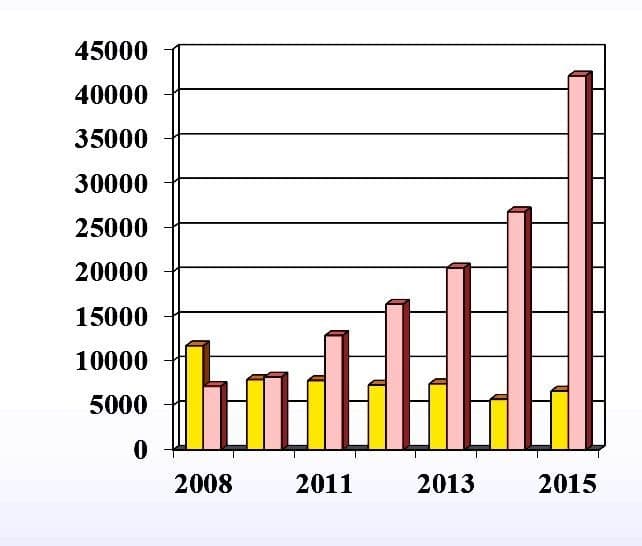
Persons under supervision - the situation at the end of 2015, as compared to the past:

The activity of the probation counsellor in relation with the persons deprived of liberty:
- participates in the preparation for conditional release of the detained persons, by developing different programs.
- participates in the development of commission’s works for the conditional release of persons deprived of liberty.
- participates in the works of the educational council organized within the educational centre, namely within the commission of the detention centre.
- draws up assessment reports in case of a proposal to replace the educational custodial measure with the measure of daily assistance and conditional release of the minor from the centre.
- makes proposals of obligations in case of major persons who are proposed to be conditionally released as they have less than 2 years to serve, upon the conditional release.
Social reintegration programs developed by the probation officers:
ONE TO ONE
- Objective: development of cognitive skills.
DEVELOPMENT OF MINORS’ SOCIAL SKILLS
- Objective: development of social skills necessary to avoid risk situations which can lead to repeat offense.
STOP! THINK AND CHANGE
- Objective: development of alternative reasoning.
DEVELOPMENT OF ADULTS’ SOCIAL SKILLS
THE TECHNIQUE OF „MOTIVATIONAL INTERVIEW”
- Objective: the identification of the motivational stage of the convicted person and the formation of the motivation to change.
REDUCTION IN THE RISK OF REPEAT OFFENSE
- Objective: the preparation for the release and post-criminal assistance of prisoners who have less than 3 months of the penalty to serve.
DRINK AND DRIVE
- Objective: the reduction in the risk of repeat offense of persons convicted for the commission of public road offenses, being under the influence of alcohol, by generating changes at cognitive and behavioural levels, as well as the improvement of the public road safety by reducing the number of victims of traffic accidents caused by alcohol consumption.
INSTRUMENT OF DATA COLLECTION AND DIAGNOSIS
- Objective: the identification of risk factors by using a structured assessment.
ANGER MANAGEMENT
- Objective: the increase in behavioural self-control and in the capacity to manage conflicting situations.
Probation and community services
For the development of its specific activities, the National Probation Directorate collaborates with competent community institutions and with other public institutions and non-governmental organizations on the basis of the collaboration protocols.
The community may be involved in the following activities:
- following a professional training course;
- following a professional reintegration program;
- performing community service;
- subjecting to certain control, treatment or medical care measures;
- following civic traineeships;
- other concrete activities established in the non-custodial educational measures.
Taking into consideration the role and the importance given to the institutions and the non-governmental organizations in the process of service of penalties and non-custodial measures, their adaptation to the Probation Minimum Working Standards is one of the most importance.
After 2014, when new previsions came into force, Romanian probation system are challenged with: overcrowding, change of the profile of people in probation, new procedures for probation practice, new administrative procedures, new staff and new organization. But we succeed in decreasing the prison population, reducing the costs and educating the community.