


An Alternative To Prison
An Alternative To Prison
What happens when 40,000 prisoners, according to the new probation law, when they will be released from prisons and dissolve in society? Exclusive.kz met with the Dutch developers of the project, compared the European reality with Kazakhstani one and figured out the essence of the law on probation.
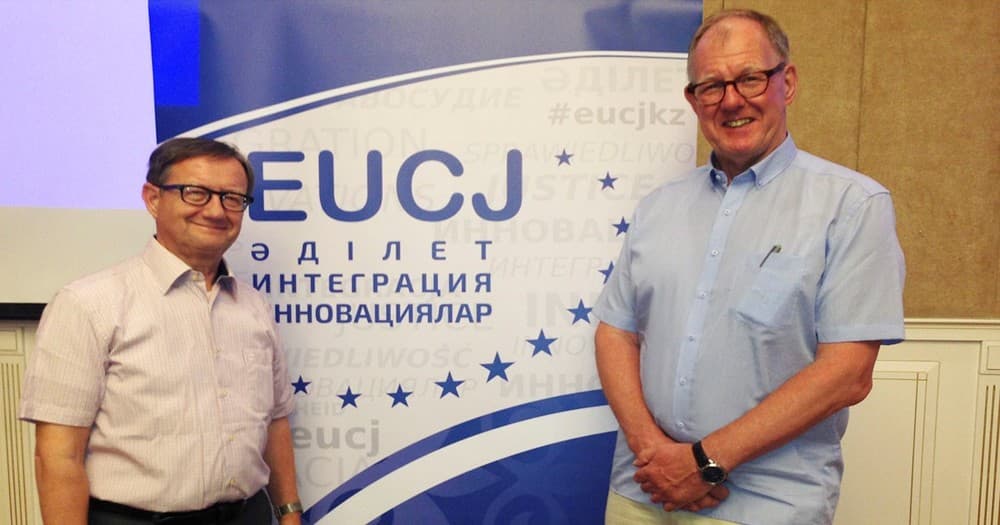
Our experts:
Ben Zengerink – Deputy Head of the EU project on “Enhancing criminal justice in Kazakhstan”; he has been working on the development of the Dutch probation service for 40 years
Leo Tigges - International expert on probation of the EU project on “Enhancing criminal justice in Kazakhstan”. He is also Former Secretary General of the European Organization for Probation.
You participated in the development of the probation law. Have you managed to delve into the subtleties of the existing criminal legal processes in Kazakhstan?
B.Z.: Our project is called "Enhancing Criminal Justice in Kazakhstan." It was launched a year and a half ago and is designed for 3 years.
Our work encompasses not only probation procedure, which is the most visible part of our work, but also the entire introduction of changes in the process of administering criminal justice. In particular, we are working with the state prosecution and we have an extensive program aimed at modernizing the activities of the prosecutor's office. In a short time, we are planning to start working with the Supreme Court of Kazakhstan, and at the moment we are discussing the question of assisting the Ministry of Internal Affairs. We are also working with the committee of the penitentiary system - an organization responsible for supervising probation and correctional institutions in the country. Long story short, the main goal of our activity is to ensure the safety of your society.
In what ways can European approach help Kazakhstan?
Soviet system’s legacy is easy to notice. There are many bureaucratic processes as well.B.Z.: Our project is funded by the European Union. Its amount is 5.5 million euros. It is aimed not only at creating a legal framework, but also at developing the so-called soft power and supporting professionals who are promoting the very changes we are now talking about. What we see now at all levels, be it the work on legislative acts or the activities of professional organizations, is often a reflection of the Soviet system’s legacy. There are many bureaucratic processes as well.
Obviously, many decades had passed before you established current system of probation in Europe. Our path is only beginning. In Kazakhstan there is a clear division between those who are behind bars and the rest of society. Life in prisons is under the control of power structures and is in complete isolation. Does your program provide any changes that create favorable conditions for creating an inclusive society where those who have been behind bars have a real chance to return to a full life?
Our fears lie in the fact that you have a bunch of organizations that develop too fast.B.Z.: As I said, this is a process that involves a phased development. Revolution is not its characteristic. This is a painstaking work. As for the readiness of the Kazakh society, I will say the following: I have met people who are absolutely ready to accept those released from prison both among passers-by in the street and officials involved in issues of probation. Today we have 70 professionals who are ready for a new approach. Nevertheless, I also met those who are not only unready, but also indifferent to the problem. But, since you have main drivers of changes – probation service and prosecutor’s office – I keep being an optimist. Now we are talking about internal processes. In order to achieve an effective result, it is necessary for the representatives of the entire system of criminal and law enforcement justice (police, penitentiary system, courts) to undertake joint efforts. This involves the development of effective security policies at the national and local levels.
It is not simple. In a sense, my fears lie in the fact that there is a bunch of organizations in your country that are developing too fast, even compared to the Western methodology we are talking about. They are far ahead of their peers. However, in order to achieve success and ensure sustainable development, it is also necessary to run similar programs in the Supreme Court and the Ministry of Internal Affairs. Otherwise, there is a risk of imbalance between various government structures and these organizations.
We need to focus not only on helping the offender to adapt to a new life when released from the correctional institution, but also on considering the possibility of replacing imprisonment with an alternative sanction.L.T.: You asked whether society is ready for this drastic change. The mere fact that the Kazakh parliament has passed the law on probation is already a big step forward. The two most important elements of the law are: a) preparation of the offender for release, return to society as well as the parole; B) developing a pre-trial report for the judge to recommend a decision concerning the offender. We need to focus not only on helping the offender to adapt to a new life when released from the correctional institution, but also on considering the possibility of replacing imprisonment with an alternative sanction.
The meaning of the processes you are talking about is noble. Moreover, it was tested and works efficiently in developed Europe. But, while living in Kazakhstan, it's difficult to ignore the fact that power and people live in parallel universes. It is important for the state to be placed in the list of 30 competitive countries in the world. However, it becomes impossible without adopting the law on probation. What perspectives are there for the people?
We are convinced that it is impossible to change a person for the better using repressive methodsB.Z.: You are absolutely right. It is important to understand that all these changes will not happen next week. When you ask about Kazakhstan’s readiness, from the perspective of legislative base the country is absolutely ready. Of course, in the very beginning of the project, no one expected that in a year and a half we would have a result. The foundation is laid, and this is already a huge achievement. Now we want to see changes in practice. To achieve successful indicators, it becomes necessary to motivate people, promote ideas and form a pool of professionals whose quality will be at the highest level. These people have to come up with a quite different approach. When I first came to Kazakhstan, I was sure that there was no probation in your country. I was told that this was not the case and KUIS (Committee of Penitentiary System) was dealing with citizens who were returning to society. However, that work was of a repressive character. We are convinced that it is impossible to change a person for the better using repressive methods. To make society safe, it is necessary to change people’s worldview, and this takes time. Nevertheless, it is worth mentioning that I perceive my colleagues from the KUIS as open people, who are ready to stop being a repressive body and adopt other methods of work.
Moreover, I am sure that people currently undergoing training has already changed their view of probation. The only thing that we are now actively developing are questions of competence. On the other hand, you are absolutely right in focusing on the lack of society’s awareness. KUIS (Committee of Penitentiary System) has to do a lot of work in its attempt to clarify probation issues as well as the prospects arising from it.
I had experience working in Romania that also has a Soviet past. Based on the experience of this country, I can say that it would take at least 10 years for things to change. Even in Holland, when asked about the definition of probation, not everyone can give an adequate answer.
A society that does not invest in offenders’ rehabilitation is less safe for its own citizens.
Another stereotype that you have to overcome lies in understanding the need to spend money for offenders’ rehabilitation. There is an opinion that the person, who committed the crime, does not deserve an investment. Then let's put the person in the cell and throw out the key. There is a whole range of evidence showing that a society that does not invest in the rehabilitation of offenders is less safe for its own citizens. Therefore, if you invest money in education, in rehabilitation, oversight practice, program development, then in the long term it becomes favorable for the society itself.
I am convinced that penitentiary system in Kazakhstan must undergo certain reforms. This should be done not only to isolate citizens from society, but also to deal with those released from prison.
All this requires a review of the penitentiary system’s structure, as well as the new ideology and different thinking of the penal system’s staff. Considering that this is not the most open system in Kazakhstan, our task might be challenging.
I have been living in Astana for a year and a half, and my wife is a KazakhB.Z.: That idiom is understandable: I've been living in Astana for a year and a half, and my wife is Kazakh. I know a little more than those foreigners coming here for a while. Therefore I have an idea of the police-society relations.
I would like to talk about Holland, where people are surrounded by water and are forced to constantly think about their safety. We used to build dams on the shore, however, now we have a new strategy. We begin to defend ourselves on the outskirts, that is, at sea. Research had been conducted and water currents had been studied. Nowadays, if you look under the water off the coast, you will see sand mounds there. They perfectly cope with the protection of the coast by distributing water flows. Such practice does not require previous colossal efforts. The sand, which is at the bottom for a long time, continues to work and strengthens the embankments. In other words, it remains the part of the defense system. Here, in fact, we do the same - we strengthen the embankments, and once we can fully strengthen the bottom, we can consider the project completed. The rest would depend on you.
If to speak about probation officers, one have to bear in mind that they finish law enforcement institutionsIf to speak about probation officers, one have to bear in mind that they finish law enforcement institutions. In other words, if you graduate from this academy, you become the part of a certain culture. From this point of view, cooperation is very important.
Civil society’s influential representatives support all our initiativesWe cooperate with both academies (the Kostanay Academy of the Ministry of Internal Affairs and the Academy of Law Enforcement Agencies at the General Prosecutor's Office) that train specialists. Both of them asked us to help with the selection of the teaching staff and to assist in the training program preparation. I think this is a very good sign that demonstrates a willingness to take responsibility. Both organizations can take the initiative and probably would be the only ones ready for such reforms. An important element lies in the fact that the management of these academies has an excellent idea of how this process should be implemented. Now they are trying to find a way for the gradual introduction of reforms. One of the main tasks of the project is to find these very initiatives and people who can promote them. Then we can connect them.
Thus, in the long term, we are talking not just about developing legislative acts by different groups of people, but also about working together. I am glad that civil society’s influential representatives support all our initiatives.
We do not sell you a ready-made Dutch or European product. The essence of our work lies in recommendations that you are working on, and in the end, you get a ready-made Kazakhstan productWhat is the difference between others and us? We do not sell you a ready-made Dutch or European product. The essence of our work lies in recommendations that you are working on, and in the end, you get a ready-made Kazakhstan product
Those, who now work in the Prosecutor General's Office, are all supporters of the idea of organizational modernization.When you live in conditions of a directive society with top-bottom instructions, the only thing that remains is to wait. Otherwise, you risk being punished. You talked about the Soviet legacy; over the years, genetic memory has been lost. But now, while rendering assistance to Kazakhstan partners, I am amazed by what is happening. Of course, much remains to be done, but even now .
Those, who now work in the Prosecutor General's Office, are all supporters of the idea of organizational modernization. And everyone understands that enough time should pass to see significant results.
Obviously, substantial financial resources are allocated for such large projects aimed at modernizing and developing the society. And since you live in Kazakhstan for a year and a half, you should understand the relevance of the phrase "corruption as constituent". When you are talking about trainees’ enthusiasm, do you consider their motivation to be purely professional? Have you ever seen a prison from the inside?
We do not have to deal only with the surface of the problem. Of course, you need to solve the issue of corruption as well.B.Z.: We do not have to deal only with the surface of the problem. Of course, you need to solve the issue of corruption as well.
I was in one similar institution in Atbasar, but did not visit residential barracks. There I came across prison administration’s representative who put maximum efforts to involve prisoners in the work processes. It reminded me of old-style Dutch prison.
We must understand that prisons are universities where person develops his or her criminal skills.We must understand that prisons are universities where person develops his or her criminal skills.
The purpose of probation is to prevent losses to society. Of course, it is important to differentiate criminals based on their crime’s classification. For example, in Holland a verdict is carried out outside the prison walls if the person is sentenced to a term of up to 12 months. We do not need to give much importance to putting a person in prison and isolating him/her from the rest. Such methods do not guarantee the safety of society.
If to speak about prison culture, I perfectly understand what you mean. Perhaps, in our case everything can be a little more civilized. But even in Holland we have a criminal world with its own established hierarchy.
Of course, society protests. How does the government allocate state budget? Is money being managed for making criminals better in their criminal affairs?
Probation is a good alternative that proved effective in changing peopleSince prisons we have now are remnants of the Soviet epoch, I believe that Kazakhstan needs to invest in building new models. However, before building a prison, we need to develop probation service. Probation is a good alternative that proved effective in changing people.
It has been scientifically proven that the risk of recidivism in those who have gone through the probation system is significantly lowerMeanwhile, prisons in Holland are rented out…
Now we are working on developing a program to record a risk system that can diagnose an offender before he is brought to trial. Moreover, this system would be able to make certain predictions for his/her (offender’s) future based on the risk account included in the program. In addition, the system takes into consideration life circumstances and calculates whether this person can pose any threat to society. Thus, this analysis helps us to understand whether a citizen is able to change and become an integral part of community.
It has been scientifically proven that the risk of recidivism in those who have gone through the probation system is significantly lower. But there will always be a group of people who are completely incapable of changing. These people either have mental disabilities, or simply do not want to change and will never change. This group of citizens needs its own program, be it surveillance or complete isolation, to ensure that offenders do not harm the society. We must admit that there are offenders committing crimes that require many years of imprisonment.
If we compare the prison population of Kazakhstan and Holland, one can see significant difference in the ratio of number of people living in the country and those who are kept in prisons.
L.T.: If we compare the prison population of Kazakhstan and Holland, one can see significant difference in the ratio of number of people living in the country and those who are kept in prisons. Some countries prefer to place the offender in prison immediately, thus acting by repressive methods. However, nowadays it is important to search for new approaches and try to finds ways for individual’s rehabilitation.
This is our goal - to show Kazakhstan that penitentiary system can be quite different and in the long term less expensive as well. As a result, the crime rate will noticeably decrease while society will become safer.
In other words, if we want to live in a safe society, then should the adolescent, who stole the ram, be set on the right track rather than sent to the juvenile prison (correctional facility)?
Absolutely right. The United States has the largest number of prison populations while the level of security is one of the lowest. According to one study, annual investments in correctional system and the maintenance of prisons would have allowed the American society to ensure the stable development of social programs for 20 years.
Translated by the EUCJ intern Aizhan Abilgazina
Original article in Russian can be found here: http://exclusive.kz/alternativa_tyurme